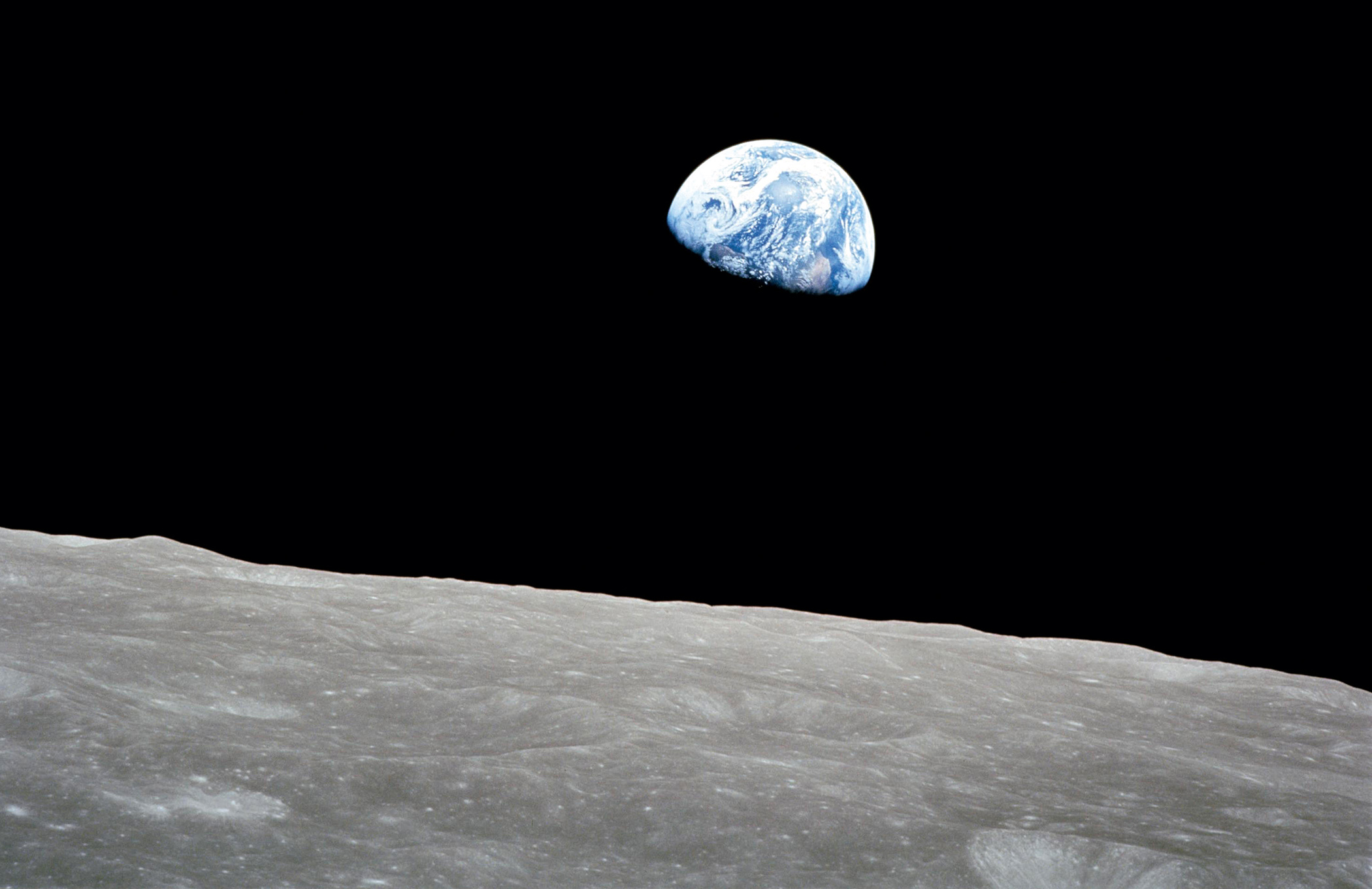
In 1968 astronauts on the Apollo 8 mission – the first time humans orbited the moon – took the iconic ‘Earthrise’ image. Its evocative reversal of perspective captured our planet as a fragile marble of life suspended in an endless, inky-black void, rising above the moon’s barren surface.
The photograph has been credited with helping propel a burgeoning environmental movement and inspiring the creation of the annual ‘Earth Day’. According to Earth Day’s president, Kathleen Rogers, ‘Earthrise instilled a sense of urgency for those who were already on the front lines battling pollution and making the case that our health and planet were in danger’.
The grainy image was given a highresolution update this April when Nasa’s Artemis II mission completed its lunar flyby.1 But this time, instead of an increased focus on protecting the earth, the Artemis II ‘Earthset’ shot coincides with an investment frenzy, destroying fragile ecosystems and livelihoods.
Space is essential for our everyday tech. Meteorology, navigation and global communications all depend on networks of satellites. For military users, access to space is a growing geopolitical necessity. There are tens of thousands of satellites currently in orbit.
The lion’s share of those were launched from the US by Elon Musk’s SpaceX. But with Trump’s tariff threats and Musk’s far-right sympathies, governments and companies no longer see the US as a safe pair of hands. Across Europe and elsewhere, states’ interests in sovereign launch capabilities have rocketed. And so has the development of spaceports. For the last four years I’ve travelled from the far north of Europe to remote Pacific islands, exploring their development and how Indigenous, poor and marginalized communities are standing against them.
Squeezed from all angles
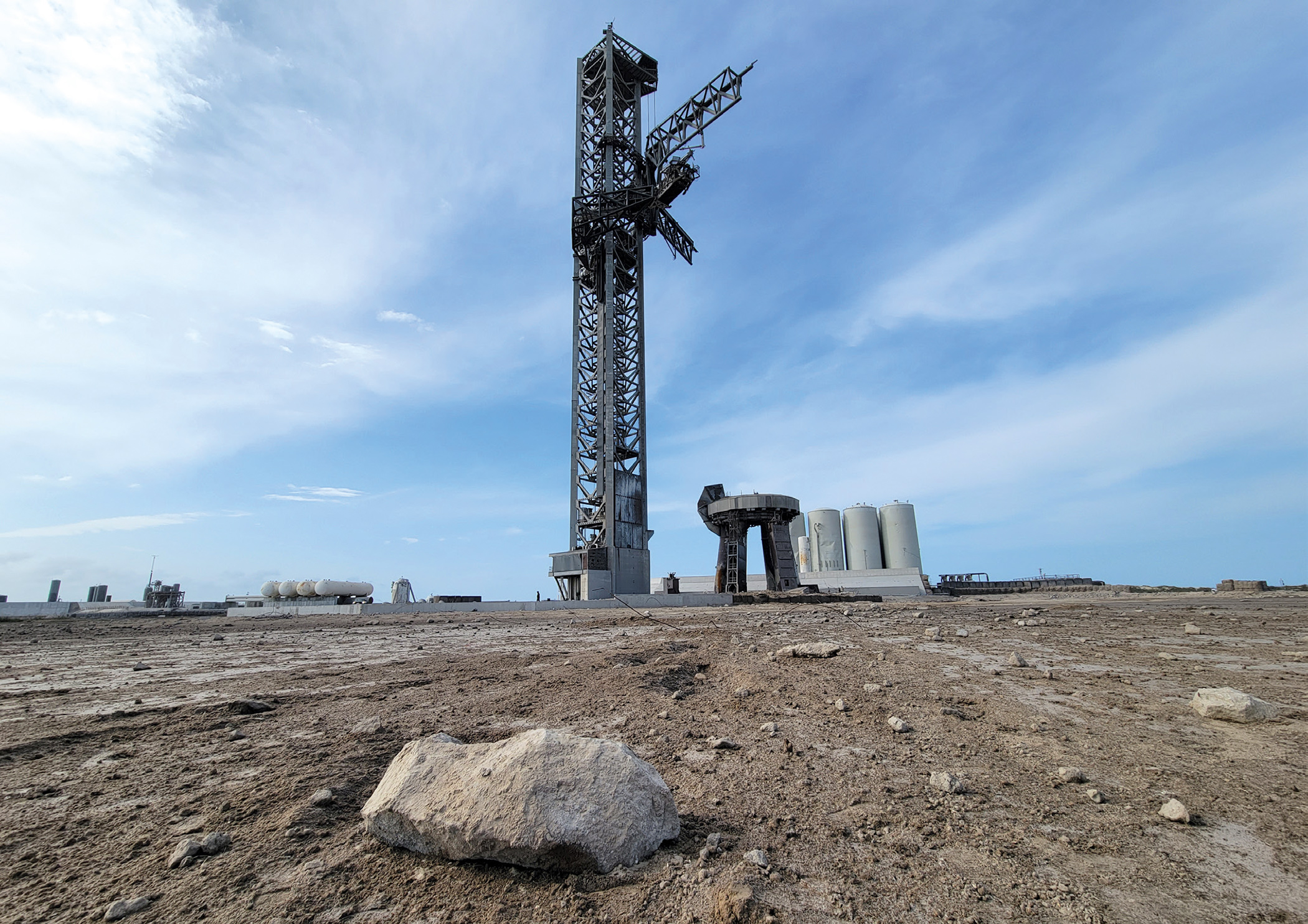
The geographically isolated border-town of Brownsville in Texas ranks among the poorest in the US, but its economic challenges and remote location have made it an ideal sandbox for grandiose experiments in economic development. As well as giant oil and gas facilities and automated weapons factories, Brownsville hosts the world’s largest private spaceport. SpaceX’s Starship programme – the world’s largest flying machine, purportedly aiming to take people and cargo to the moon, or maybe Mars – dominates Brownsville’s Boca Chica beach, the ancestral heartland of the Carrizo/Comecrudo tribe, where SpaceX’s Starbase launchsite is located. The mouth of the Rio Grande river at Boca Chica is their most sacred site, which many feel is being turned into a sacrifice zone.
While walking along the beach with tribe members we’re stopped and searched on several occasions by US Border Force agents. ‘We’re being squeezed from all angles’, says the tribe’s chair, Juan Mancias. ‘There’s the [US/Mexico] border wall, a huge LNG export facility, the Rio Bravo Pipeline. And now SpaceX. We never gave our consent to any of this.’
As well as closing off coastal access during launches, SpaceX is currently looking to acquire hundreds of acres of state park land – sensitive algal flats for shorebirds – in return for lesser-value scrubland that the company has already enclosed.2
Local resident Sadie Hernandez believes that the politicians who are interested in the land swap do not have the people’s best interests at heart. ‘They just want the validation and the fantasy that they’re rubbing shoulders with Elon Musk,’ she adds.
In May 2025, a referendum among residents – most of them SpaceX workers – enabled Musk’s Starbase site in Cameron County to become a charter city effectively controlled by SpaceX.3
Starbase has been accused of skirting environmental laws by allowing toxic runoff from their launch pads to flow directly into nearby waters, while massive sonic booms damage houses.4 In April 2023 wreckage from the first failed SpaceX Starship test was scattered over 385 acres of Boca Chica park, causingfires that burned habitats for endangered birds and ocelots. Since then five other SpaceX Starships have exploded. Each ‘rapid unscheduled disassembly’ – as the company jokingly refers to them – causes toxic compounds including lead to rain down on communities below.
Broken promises
While US start-ups seem to be the clear winners in the new space race, growing defence spending and a push for greater independence from shifting US space and trade policies means Europe is creeping forwards with homegrown spaceports.5
Several British projects are at various stages of development – some have already failed. The first ever UK spaceport licence was awarded to Spaceport Cornwall, at Cornwall Airport in south west England. The first launch attempt, in January 2023, ended in disaster.
A faulty fuel filter meant that satellites due to be released from Richard Branson’s LauncherOne rocket never made it into orbit – instead they landed in the Atlantic Ocean. The jobs promised for the locals below ended in the wrong kind of fireworks; Branson’s company Virgin Orbit filed for bankruptcy soon after. The firm laid off most of its workforce before shutting up shop forever.
I saw a similar story play out in the north of Scotland. Based in the town of Forres, Orbex employed 150 staff. The company hoped to develop a rocket for use in launching small satellites into low Earth orbit from their own dedicated spaceport in Sutherland. The development was planned on a peatland bog (themselves important stores of carbon), part of the Flow Country peatland, a delicate and highly flammable UNESCO world heritage site.6
Despite securing £77 million ($104 million) from the UK Government and the Scottish National Investment Bank, neither a rocket nor a spaceport ever materialized.7
Rachel and Ian Broughton own a croft (smallholding) near Tongue, at the very north of Scotland, alongside which Orbex hoped to develop an access road to transport their heavy machinery to a proposed antenna park.8 The couple’s ancient croft house was traditionally built with limited foundations. The level of proposed development would have destroyed it, they believe.
‘The news of Orbex’s long anticipated collapse was very welcome,’ says Rachel. ‘Whatever happens we won’t have to try to deal with them again. But the uncertainty is as difficult to live with as ever. Our worry now is who might take over the spaceport.’
State development agencies have hung high hopes on the promise of new space-related jobs for communities of the Scottish Highlands and Islands which are suffering declining populations. Without new ways to attract younger people, the outlook is bleak. According to the Scottish statistics office, 18 per cent of families have left the Outer Hebrides – the chain of islands at Scotland’s northwest – since the 1980s. Its young population (those aged 15-29) is expected to decrease by 38 per cent in the next 15 years.
In the Outer Hebridean island of North Uist, Spaceport-1 plans to launch sub-orbital rockets within a kilometre of existing homes. Despite receiving 244 individual public responses in opposition, including a petition with almost 1,000 signatures, construction of the spaceport is ploughing ahead.
Angus MacNab, whose small holding lies just 800 metres from the launch pad, is one of the leaders of local protest group Friends of Scolpaig. ‘The developers have not been fully honest about the impact to the environment,’ he says. ‘We know the wildlife will be impacted and carbon emissions will be 30 times higher than what the site owners had assured the local planning authority.9
‘It’s an understandable error, when you realize both the developer and the planning authority are the same council body.’
Reindeers or rockets
In the far north of Sweden, Europe’s mission to build sovereign launch capabilities is colliding with a growing appetite for rare earth elements. I visited the town of Kiruna, 145 kilometres north of the Arctic Circle, where Esrange spaceport has established a 5,600 square kilometre ‘impact zone’ for falling rocket parts following a launch. The town is home to one of the world’s largest iron mines, which is eyeing an expansion to extract valuable ‘rare earth minerals’ (See NI547, ‘Some things are priceless’). But already the mine has caused subsidence necessitating a decade-long relocation of homes and buildings, including a 114-year-old timber church.
Kiruna sits in the centre of Sápmi, the traditional homeland of the Sámi people. As Sweden’s Indigenous population, many in Kiruna practice traditional semi-nomadic reindeer herding. Within the spaceport’s impact zone, Sámi herders are a community in crisis.
One local herder told me, ‘We are given only a few days warning of planned launches to move the reindeer. There’s no protection for the reindeer of course, which are not easy to hurry and use migration routes that are hundreds of miles long.’
Another herder living near Esrange explained that, ’When [the spaceport operators] injure the reindeer, they ask me to put them out of their misery. We are meant to live our lives like this. We have to listen to the radio and if [Esrange] say they want to launch something, we have to run.’ Meanwhile space debris pollutes their territory.
(The European Space Agency, a major user of the spaceport, emphasizes the ‘safe’ impact area on its website, saying that Esrange ‘looks after’ Sámi herders, including through a ‘helicopter-borne loudspeaker’ warning them to take cover before launches.)
The rate of depression and suicide among the Sámi is four times higher than among their Swedish peers. The threats to traditional livelihoods posed by a rapidly changing environment are key factors in this mental health crisis, research suggests.10
‘Where today the municipality is developing a soulless shopping arcade, that is where our reindeer used to birth their young,’ says Nils Joel, a reindeer herder and vice president of the Sámi youth organization, Sáminuorra. In March 2025, the group organized a ceremony to confront the expansion of the mine and spaceport. ‘We made offerings at that spot to say sorry to the land and to the friends we have lost.’
‘We are the nature people,’ says Frøydis Nystad Nilsen, a Sámi psychologist. ‘When you lose your land, you lose your identity.’
Built on blood
For the Warbon people of West Papua, losing their customary lands to highly speculative space projects was just another chapter in an ongoing struggle for self-determination. On the island of Biak, the Indonesian government claim to be developing Southeast Asia’s first spaceport. Potential buyers include the Russian space agency ROSCOSMOS and Elon Musk.11
Lying slap-bang on the equator, Indonesia’s space agency (LAPAN) claims the island is an ideal satellite launch site for telecommunications, television and weather monitoring. I visited in 2022, when proposed clearances for the spaceport were reigniting ethnic tensions and fears of military violence.
For the Warbon people of West Papua, losing their customary land to highly speculative space projects was just another chapter in an ongoing struggle for self-determination
The threat was very real. Back in July 1998, Biak was the site of the worst massacre in the history of Indonesia’s occupation of West Papua. Between 40 and 150 suspected members of the outlawed Free Papua Movement (OPM) were gunned down by the Indonesian military at a pro-independence protest. Bodies were dumped at sea in what became known as Biak Berdarah, or the Bloody Biak Massacre. The space agency’s involvement helped stir up tensions: Papuans who had refused to give up their customary lands to LAPAN were branded as OPM members.
Decades later a spaceport is yet to materialise. Some see the promised development as a way for the Indonesian government to move undesired populations.12 Others see the plans as a means to attract investment from Russia, or as a way to sell the country’s nickel reserves to Musk’s Tesla car company.
As for Musk, he’s now talking up plans for a SpaceX factory on the moon, sling-shotting AI chips into orbit using an electromagnetic ‘mass driver gun’. While for him the moon is just a barren rock, for the Navajo Nation the moon is sacred. According to the Navajo Nation’s president Buu Nygren, ‘the sacredness of the Moon is deeply embedded in the spirituality and heritage of many Indigenous cultures, including our own.’
Across all the spaceports I’ve visited, it’s clear that the vision proposed by deep-pocketed elites for humanity’s future in space is not universally shared. Devising a more sustainable way forward for our fragile marble requires listening to diverse perspectives, including Indigenous peoples who understand space as common heritage. The new space race may otherwise prove every bit as unjust as any past colonial conquests.
- NASA, ‘Earthset’, April 2026, a.nin.tl/earthset
- US Fish and Wildlife Service, ‘Potential Land Exchange in South Texas’, 2026, a.nin.tl/landswap
- Nick Robins-Early, ‘Elon Musk’s company town...’, The Guardian, May 2025, a.nin.tl/Musktown
- Lora Kolodny, ‘SpaceX repeatedly polluted waters in Texas…’, NBC News, August 2024, a.nin.tl/broken. Ayden Runnels, ‘South Texas residents suing…’, The Texas Tribune, 1 May 2026, a.nin.tl/texas
- ESA, ‘Report on the Space Economy 2025’, March 2025, a.nin.tl/ESA2025
- University of Cambridge, ‘UK peatland fires are supercharging carbon emissions…’, February 2025, a.nin.tl/peatfires
- Brian Donnelly, ‘Taxpayer faces £70m loss..’, The Herald, 21 February 2026, a.nin.tl/Orbex
- Alison Campsie, ‘Spaceport moves to mountain summit…’, The Scotsman, November 2024, a.nin.tl/spaceport
- Eve McLachlan, ‘Scolpaig spaceport carbon footprint could be over 30 times…’, Press and Journal, August 2023, a.nin.tl/4b
- Melody Schreiber, ‘In a land of thundering reindeer, suicide stalks the indigenous Sami’, PBS, December 2016, a.nin.tl/samidistress
- Rory James, ‘Anger after Indonesia offers Elon Musk Papuan island...’, The Guardian, March 2021, a.nin.tl/biak
- Dera Menra Sijabat and Richard C Paddock, ‘Will an Island in Indonesia Become a New Frontier…’, The New York Times, November 2021, a.nin.tl/4c
