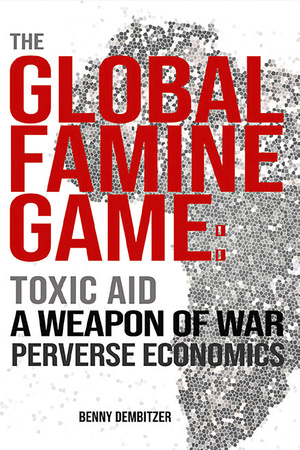
The Global Famine Game
Toxic Aid, A Weapon of War, Perverse Economics
by Benny Dembitzer
(Independently published, ISBN 9798307359105)
fightglobalpoverty.com
‘Angry’ is the word used on the dustjacket. That anger is more than justified. As Benny Dembitzer notes, ‘starvation is the fate of more than 30,000 people every day’ in the Global South, amounting to ‘at least nine million deaths each year’. What’s more, such horrific levels of poverty could be avoided if it wasn’t for ‘the overarching global political and economic systems [that] keep the poor in their place’.
For decades, the world has been ‘sleepwalking into a global famine’, Dembitzer writes, the situation now being exacerbated by the worsening impacts of climate change. His ire is directed at multiple sources, including ‘governments of the rich world [which] could tackle the root cases if they really wanted to’ – ‘but they do not’. Global financial institutions, such as the World Bank and the International Monetary Fund (IMF), are, Dembitzer suggests, designed to maintain profits for wealthy countries and corporations, rather than helping developing countries. Conglomerates are allowed ‘to dictate the price of food’, while multinational corporations and international markets determine what crops can and can’t be grown. And the poor have no bargaining power.
Dembitzer details how aid donated by governments, United Nations agencies, international organizations, philanthropists, charities and individuals ‘has not only failed to solve but has even worsened the conditions of millions of our fellow human beings’. Well-meaning NGOs and aid giants often have harmful short-term goals, or try to bring in ideas that are a poor fit for the reality on the ground. Meanwhile, ‘the cowboys of the aid world’ are enjoying ‘a gigantic con game, whereby aid feeds the aid community’. For them, ‘the perpetual crisis is actually very good news: there will be more money to be made and more grandstanding and prestige to gain’.
There have been other books before on the failings of international aid, such as Dambisa Moyo’s Dead Aid and photojournalist Guillaume Bonn’s recent Paradise Inc. What makes
The Global Famine Game particularly damning is that Dembitzer, a British economist, has spent much of his career working within the system he’s criticizing – with numerous UN agencies. He’s now ‘deeply ashamed of not having fully understood the bigger game in which I was a pawn’.
It’s time to ditch ‘piecemeal’ amelioration of poverty and instead organize for ‘a radical transformation of the local and global structures that keep so many in dire poverty’, Dembitzer writes. Yet he is more effective in outlining the seriousness and scale of the problem than providing a clear road map to that global overhaul. Especially when, as he notes, so many powerful people and organizations are doing very nicely from keeping the status quo exactly as it is.
But he also suggests practical, manageable adjustments. Banks and aid outfits should realize ‘that a dose of finance on its own… is simply not the way to achieve some mythical “development”’. Rather than imposing one model, approaches should be localized. Instead of short-term quick fixes and crisis responses, there should be long-term goals. Mostly, Dembitzer suggests, that means ‘empowering local communities, promoting small-scale, sustainable practices’ to address food shortages, so people can feed themselves, rather than industrialization.
For people who want to give money to charities, Dembitzer suggests doing extensive research to find communities to help and intermediaries that can support real connections with them. One practical step, he suggests, would be to focus on feeding a Global South primary school with food bought from local farmers to ‘generate a local market’.
He also calls for more cohesive efforts from NGOs, with less waste and more accountability – including ‘score cards on success at the grassroots, not of their pronouncements at large international conferences’. It’s an idea that so obviously makes sense that you wonder why it’s not commonplace already. And how much suffering could have been avoided if it was.
