‘Wipe Gaza off the face of the earth.’
‘The children in Gaza have brought this upon themselves.’
‘For all of them there is but one sentence, and this is death.’
These chilling words, uttered by high-ranking Israeli politicians in the months after 7 October 2023, are not anomalies. In the past two years, explicit calls for the eradication of Gaza have become common-place in Israel’s political and media landscape. During this time, human rights group Al-Haq has recorded more than 1,000 such comments from ministers, deputies, military personnel and other public figures.1
This rhetoric however was not born in a vacuum. While it has grown louder and more explicit during Israel’s war on Gaza, calls to eradicate the Palestinian people have been a feature of the Zionist project from its inception. As researcher Patrick Wolfe noted, the impulse of settler colonial projects such as Zionism is to eliminate the native, which can mean ethnic cleansing and genocide, an impulse that other colonial empires certainly acted on.2
The uniqueness of the Zionist project was its historical timing, emerging at the end of the colonial era just as anti-colonial movements and the recognition of human rights were gathering momentum. It encountered not only Indigenous people but also an anti-colonialist liberation movement. This required the early Zionists to concoct a narrative and a discourse that concealed their real aims of elimination.
Over the years, this smokescreen became thinner as the Israeli authorities escalated their attacks. From an attempt to hide the genocidal ambitions behind the Zionist project, over time, these intentions were proudly broadcast, first internally and then to the world at large.1
The dehumanization of Palestinians was explicit in the early days of Zionism, but the movement did not possess the power to dispossess the country. However, it had already been a de-Arabized land in the fiction, poetry and paintings of the early Zionists.
Hidden orders
After the Second World War, Israel’s leaders moderated their rhetoric for global audiences, but it was not always hidden from the public at home. In whatever version they appeared, references to the Palestinians’ fate were informed by a drive to take over as much of the land as possible, leaving as few Palestinians in it as possible.3
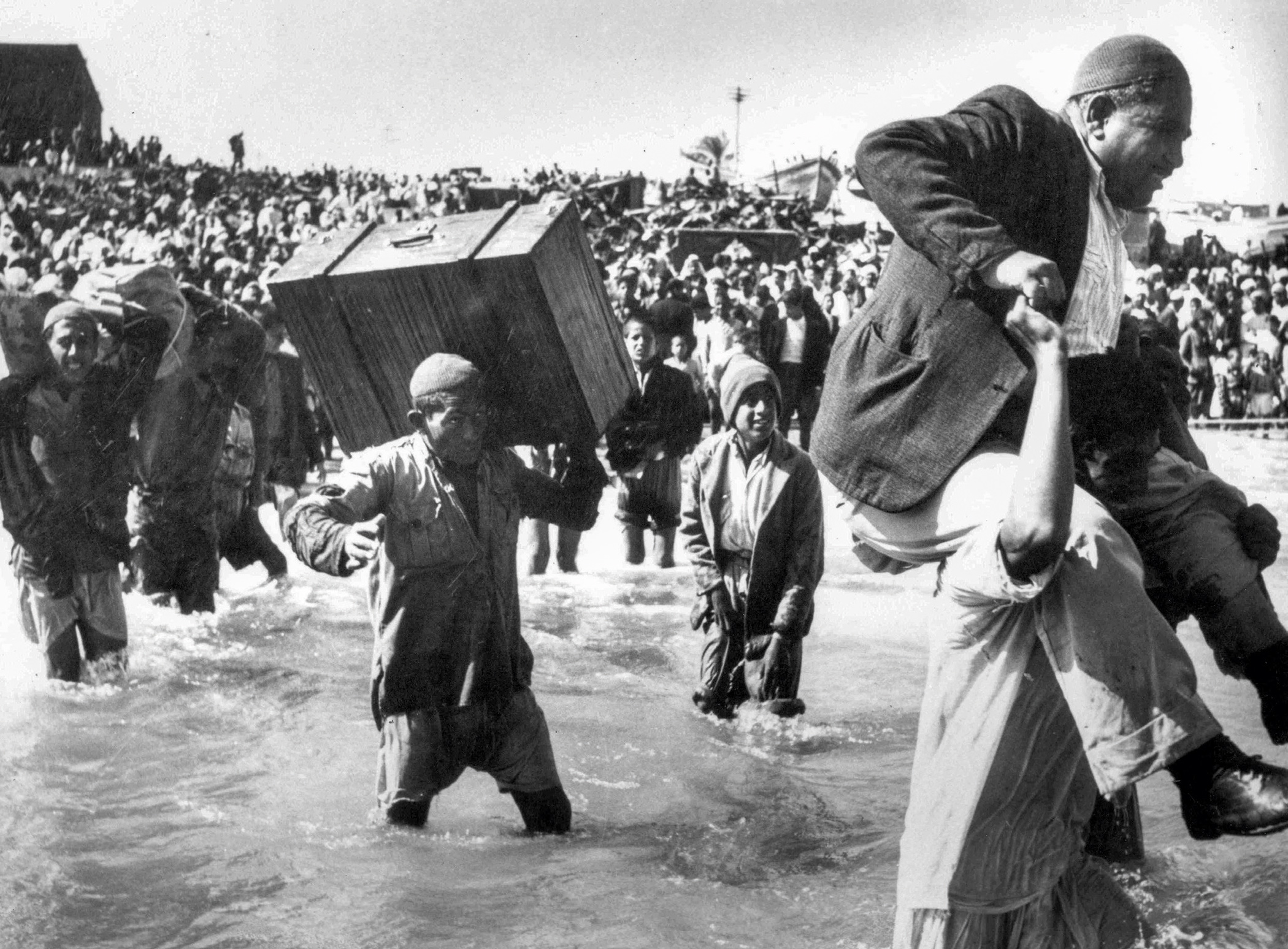
The displacement of the Palestinian people began through incremental ethnic cleansing with the help of the British during the mandatory period (1920-1948) and culminated in the massive expulsion in 1948.3 The escalation from incremental to massive ethnic cleansing also changed the language, but unlike today, it was only in Hebrew and appeared mainly in military documents and less in the public domain.
Explicit calls to eliminate the Palestinian people appeared in the commands dispatched to the Israeli troops who committed the 1948 ethnic cleansing. The verb ‘to eliminate’ now appeared in the orders sent to the military units with references to specific villages or neighbourhoods.3 More graphically, these orders included instructions to kill the men in several cases (‘men’ were defined as anyone above the age of 10), as well as the destruction of stone houses and the burning of huts.3
The Palestinian village was described as the enemy base, and anyone living in it was a legitimate target
The Palestinian village was described as the enemy base, and anyone living in it was a legitimate target. When every civilian space is defined as such, the assaults become genocidal. When the targeted spaces are among the most densely populated areas in the world, the military operations become genocidal. This was manifested clearly in the words of then-General Gadi Eizenkot, who, in a 2008 interview with the newspaper Yedioth Ahronoth, articulated his strategy.4 He declared: ‘Israel will wield disproportionate power against every village from which shots are fired on Israel, and cause immense damage and destruction... from our perspective, these are military bases’.To justify this violence, Palestinians were depicted as the new Nazis as early as 1948, including their political leadership (from Haj Amin al-Husayni during the British Mandate period to Palestinian Liberation Organization Chairman Yasser Arafat in 1982 Beirut and the Hamas leaders nowadays). Since then, comparison of Palestinians – including the ’48 Arabs (the Palestinian citizens of Israel) – to snakes, vermin or cockroaches has appeared quite often in the political Hebrew discourse.5
Over time, framing every civilian space as an enemy base hardened into a doctrine, the ‘Dahiya Doctrine’, named after the carpet bombing of south Beirut in 2006 (although it was exercised, but not in name, against the West Bank refugee camps during the Israeli operation ‘Protective Shield’ in 2002).
Lifting the smokescreen
The 21st century saw the ascendancy to power in Israel of the extreme right wing whose main characteristic was a far more explicit, and ironically honest, discourse about the real aims of Zionism with regards to the Palestinians.
The resistance from the Gaza Strip to Israel’s attempt to eliminate the Palestinians escalated both the destruction on the ground and the discourse used to justify it. After Hamas’s election success in 2006, Israel imposed a siege by land, air and sea in 2007. These actions were already genocidal from the end of 2008, when the first of three major assaults on the Strip (up to 2023) was launched. Already in 2008, several NGOs had accused Israel of having a deliberate policy of elimination against the population in Gaza.
This intention was evident clearly in the ammunition used by the Israeli army since 2008. It included DIME (Dense Inertial Metal Explosives) and white phosphorus, which attracted the attention of human-rights organizations as punitive weapons meant to ‘cause extensive and unusual injuries’, as Amnesty International has put it.6 Indeed, the use of such ammunition was meant to increase the number of dead and extend the magnitude of the destruction.
The discourse was already beginning to reflect the reality; it was not yet the genocidal language we hear today per se, but it focused on the need to punish the population for electing Hamas.
During the 2014 Israeli assault on the Gaza Strip, the official discourse, under the guidance of Benjamin Netanyahu, focused on comparing Hamas to the Islamic State. This equation was broadcast in particular after the scale of the destruction of Israel’s assault – 2,202 Palestinians killed, including 526 children, in just 50 days – prompted widespread Western condemnation for the excessive use of force, but these critics were ignoring the ideological genocidal intention behind it.7
The current violence that began in October 2023 wiped out any disparity between the genocidal action and the genocidal discourse. The Hamas operation seemed to liberate Israeli politicians, educators, generals and journalists from any need to sanitize their reference to the Palestinians as ‘Amalekites’, namely the rival to early Hebrews discussed in the Old Testament, which God commanded to be wiped out as punishment for attacks on Israelites.8
Most of these and similar horrific calls to genocide were in Hebrew, but every now and then, they slipped into English by less careful politicians. The assertion was that Israel’s allies accepted the depiction of the Hamas attack as a second holocaust. Once again, ‘nazifying’ the Palestinians was meant to justify its genocidal policies, both before and after the fact.
The Zionist movement tried full elimination of Palestine in 1948 but did so while disguising the discourse around it. The Palestinian resistance, so official Israeli sources believe, provided an even better opportunity to try again.3
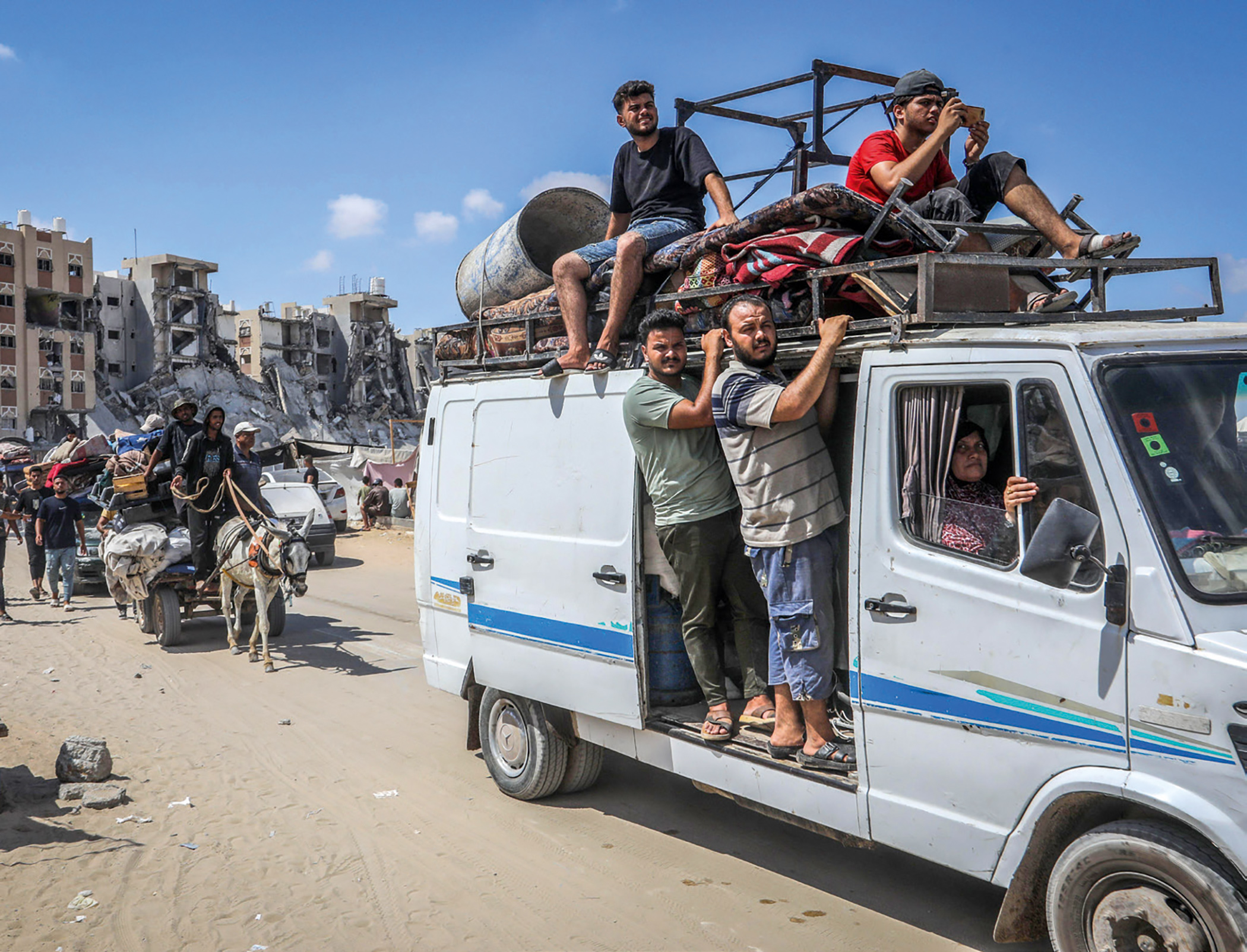
In the past, Israel’s evasive language gave the West an excuse to ignore its eliminatory policies on the ground. That excuse is gone. The incremental genocide has given way to a full-blown televised one. The question now is whether the removal of this smokescreen will finally force the West to confront the destruction wrought by the project it helped establish and sustain, and to end its impunity.
- ‘A registry of Israeli genocidal statement on Gaza’, Al-Haq Investigates, 6 April 2025, a.nin.tl/database
- Patrick Wolfe, ‘Settler colonialism and…’, Journal of Genocide Research, 21 December 2006, a.nin.tl/impulse
- Ilan Pappé, ‘The 1948 Ethnic Cleansing of Palestine’, Journal of Palestine Studies, Issue 141, 2006, a.nin.tl/Nakba
- ‘Israel warns Hezbollah…’, Reuters, 3 October 2008, a.nin.tl/3J
- Nur Masalha, ‘Expulsion of the Palestinians…’, Institute of Palestine Studies, 1992, a.nin.tl/language
- Report, ‘Rain of fire…’, Human Rights Watch, 25 March 2009, a.nin.tl/dime
- Press release, ’50 days: More than 500 children’, B’tselem, 20 July 2016, a.nin.tl/2014
- Siobhan Marin and Andrew West, ‘What is the biblical…’, ABC News, 20 January 2024, a.nin.tl/Amalek
