
.jpg "Atacama's famous flamingos have been hit by declining water and shrimp levels, affecting their numbers and colour.")
‘Look!’ shouts Solercio Barreda. ‘Just look at that!’
It’s an area of salt-flat, looking pretty much like the rough crusted surface around it that stretches for miles. Except that it’s lower by almost a metre.
‘Climb down into it!’ he urges. ‘Get a picture! Show the world!’
Barreda is a spare, long-limbed man with a mission. He walks fast, talks fast, drives fast. Screeching to a halt he reaches for a pair of powerful binoculars to scrutinize some change to the Atacama desert landscape that has been home to his Lickanantay Indigenous people for 11,000 years.
This sunken section is significant. Scientific studies published in August last year, indicated what locals like Barreda have suspected for some time – the Salar de Atacama, a vast salt flat spanning 3,000 square kilometres in northern Chile, is sinking at a rate of two centimetres a year.1
We are not far from the village of Peine, the mainly Indigenous community closest to Chile’s lithium epicentre. Two companies located here, US-owned Albemarle and the Chilean Sociedad Química y Minera (SQM), are responsible for 34 per cent of the world’s lithium supply. This makes Chile, after Australia, the second largest producer of the light white battery material considered critical to the global energy transition. Big brands like Tesla, Apple, Samsung, BASF are likely to have sourced a significant part of their lithium needs from here.
Between them, Albemarle and SQM extract more than 63 billion litres of mineral-rich brine per year from aquifers beneath the salt flat. That’s about 2,000 litres per second.2
‘We never gave them permission to mine in our territory’, says Barreda.
It’s true. Mining started here before the Chilean state signed up to ILO 169, the Convention that recognizes Indigenous rights to free, prior and informed consent before resources are exploited in their territory. Albemarle enjoys the right to mine here until 2043, SQM until 2030 with a 30-year extension planned.3
‘Come on!’ shouts Barreda. He’s running up a hillside now. It’s hot, it’s high, it’s steep. The rocks are loose. He points out Albemarle’s 18 or so evaporation ponds, like giant gleaming swimming pools in the desert. Then, further away, SQM’s larger plant and series of ponds, producing about twice as much lithium.
Black tubes sprawl over the landscape, like a tangle of dark snakes, transporting the water towards the pools.
This is a very cheap way of producing lithium. The sun does most of the work over 12 to 18 months. As liquid evaporates in successive ponds, undesired salts precipitate out and lithium becomes more concentrated in the brine. The concentrate is then trucked to processing plants 100 kilometres away and exported as lithium carbonate, hydroxide or chloride via the Chilean port of Antofagasta to battery producers in South Korea, China, Japan, Europe and the US.
Barreda veers off towards a ruined farm building where alpacas and a few wild donkeys are grazing. This used to be part of his family’s land, he says, when it was still a wetland supporting many more animals. We have a conversation I’ve had with several people already, about the physical changes in the region since mining began in earnest 40 years ago. Less water, less vegetation – and plenty of subsidence. The remaining pastoralists complain that they now need to give their animals food supplements. This might be partly due to climate change but most people believe mining is the main culprit – and you can see why.
.jpg "Recent scientific studies have proven that the Salar de Atacama is subsiding due to lithium brine extraction.")
Rugged survivors
Set in the driest desert in the world, the settlements surrounding the Salar are like oases with their own complex water system that has supported life for millennia. There are springs, aquifers, ponds and lagoons – some fresh, some saline – and many irrigation ditches. Some water comes from the mountains, via underground rivers, and clouds blown across the Andes from Bolivia may very occasionally bring rain.
The mining companies are allowed to use vast volumes of brine and lesser quantities of freshwater in their operations. In some places salt and freshwater combines. ‘Taste it!’ Barreda urges me as we approach a deep blue-green reed-fringed pool under an indigo sky. It is strange – both salty and sweet.
The biodiversity of the area is unique. Flora and fauna have adapted to extreme dryness and salt. The digestive systems of wild vicuñas help them extract maximum moisture from desert plants and process high salt content.
We stop to look at a well, one of the 308 the companies have sunk in the area. Barreda is concerned that surface water may be being taken too. ‘They’re not supposed to do that!’ A man in overalls emerges from behind the fenced-off pump. He’s big, bearded, looks North American, but is a Chilean from down South. Most company employees come from outside the area, though many locals provide connected services such as laundry and catering. ‘How is your relationship with the security guards?’, I ask Barreda as we drive up to the company’s gates. ‘Complicated,’ he laughs.
I’ve heard that water has an important spiritual significance for Lickanantay people. Is that what’s driving him? He pauses then replies: ‘As a farmer I can grow everything I need without being dependent on a supermarket. That’s spiritual for me.’
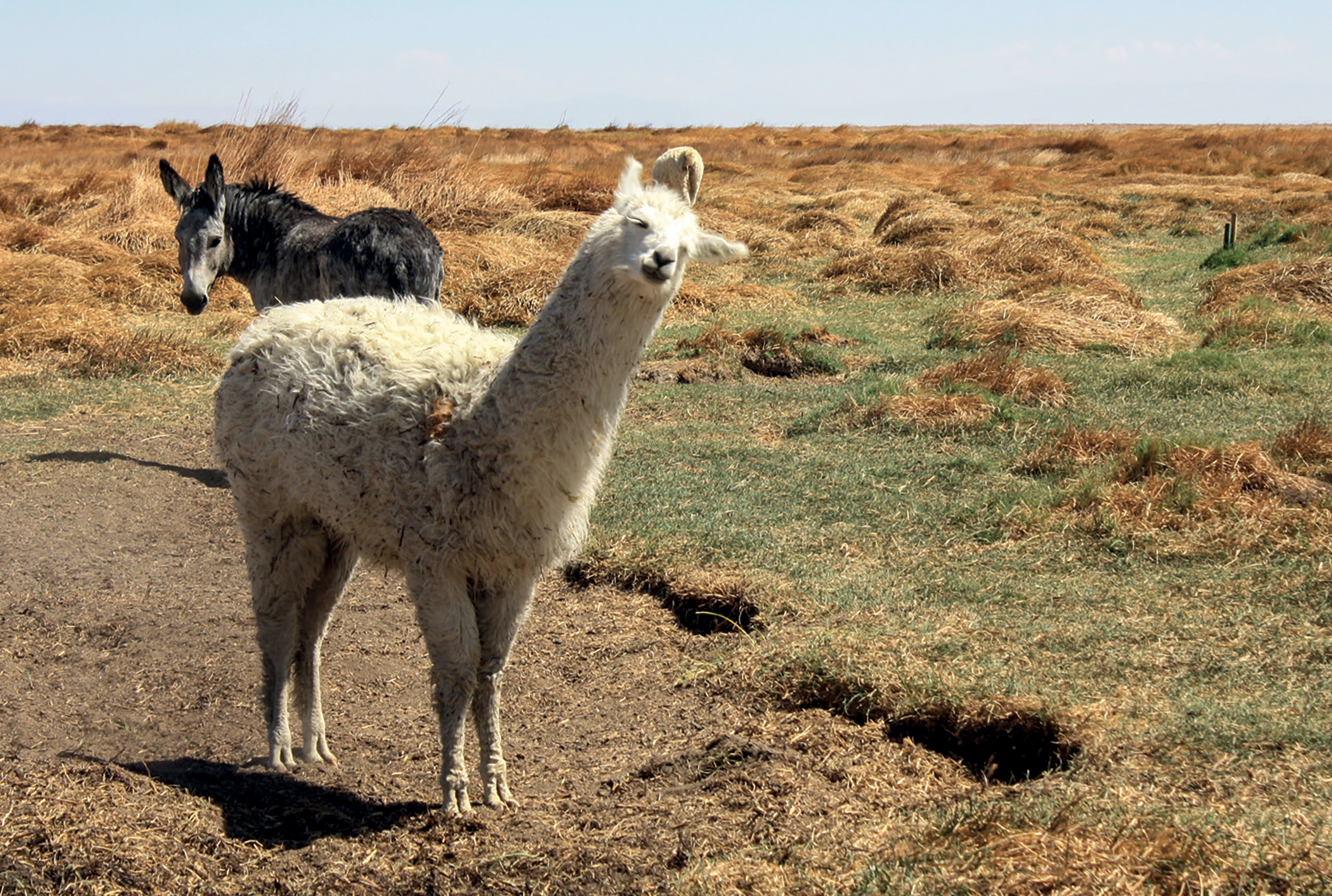
Unique biodiversity
I first meet Barreda about 100 kilometres north of Peine in San Pedro de Atacama, the area’s main municipality and tourism hub. It’s a historic town of about 11,000 residents, with traditional adobe houses, cane roofs, and fertile gardens with pomegranate trees and a rich bird life. Fundación Tantí, an environmental NGO named after a local desert plant, has an office in the town. Today it’s launching two reports and a book relating to the creation of ‘zones of sacrifice’ as Chile sets about boosting production of critical minerals and renewable energy to meet the consumer needs of the global North and its ‘green’ industries.4
Like rainforests, Andean salt-flats are capable of capturing CO2 and liberating oxygen. In spite of this, some 70 per cent of them are to be exploited under Chile’s National Lithium Strategy
For the past decade Fundación Tantí has been examining the biodiversity of this Andean wetland, which supports 21 Indigenous and other rural communities, alongside its role in climate change mitigation. Like rainforests, Andean salt-flats are capable of capturing CO2 and liberating oxygen. In spite of this, some 70 per cent of them – including those at Maricunga further south – are to be exploited under Chile’s National Lithium Strategy set in motion by President Gabriel Boric in 2023. Its stated aim: to make the country ‘the world’s main lithium producer, thus increasing its wealth and development’.5 The goal is to more than double lithium output over the next decade. Albemarle and SQM are expected to expand their production by seven per cent this year, and there are plans to open up more of the area to other private companies.6
Atacama is famous for its flamingos, boasting at least three of the world’s six varieties. An increasingly visible impact of mining, says Fundación Tantí’s director Ramón Balcázar, is the decline in these aquatic birds. I see this for myself at the Chaxa flamingo nature reserve, where locals have noted not only lower water levels but also fewer, paler birds, indicating a shortage of the shrimp that provides sustenance and the characteristic pink colouring. Seepage of arsenic from lithium evaporation pools has also been cited as a possible cause.7
Balcázar highlights the social and cultural impacts of mining. SQM branding appears everywhere, including on posters for a local Indigenous women’s cultural association it has created.
.jpg "Oriana Mora, researcher and activist from Peine (left) and traditional Lickanantay healer Sonia Ramos (right) in her garden in Solcor.")
Money and disunity
In 2016 Albemarle signed an agreement with the Council of Atacameño Peoples (CPA) to make an annual ‘contribution’ of 3.5 per cent of sales revenue to 18 Indigenous communities in the area – a large settlement by mining company standards.8
SQM later followed with a contribution equivalent to 1.7 per cent of revenue to be distributed between various authorities, including regional and municipal councils, and it committed between $10 and $15 million a year to Indigenous communities.
As a result, says Justo Zuleta, mayor of San Pedro de Atacama, ‘we have a lot of money – and a lot of disunity’. For Indigenous communities it has been a culture shock.
‘Before, the communities were very together. Now everything has become commodified there’s a lot of mistrust, often to do with the management of money’
Oriana Mora, an Indigenous activist from Peine and researcher with the lithium and human rights project of the Citizen Observatory, says: ‘Before, the communities were very together. Now everything has become commodified there’s a lot of mistrust, often to do with the management of money.’
And there’s another problem – that of representation. According to Sonia Ramos, a traditional healer from the community of Solcor, only 38 per cent of Lickanantay people are actually represented by the CPA. Many more don’t meet the criteria for inclusion in projects funded by mining – sometimes due to age, occupation or registration status.
‘Mining has led to serious fragmentation of our communities,’ she says. And competition between them: ‘Some claim to be more affected by mining than others and want more say, but the whole water basin is affected.’
For many years the CPA was viewed as the main body representing and defending Indigenous rights. After my requests for an interview get no response, I try dropping into its office. The new vice- president tells me the official policy is now to make ‘no comment at all about lithium’. I see from its social media accounts that its management committee was recently received by President Boric in Santiago. ‘The CPA has an ambiguous relationship with mining,’ comments Oriana Mora.
For Mayor Zuleta, the benefits of mining and the region’s designation as one of ‘national strategic importance’ are overwhelming. ‘I’ve never seen so much interest from ministers and governors in resolving our basic problems.’ He cites significant progress in the provision of electricity and clean drinking water, and SQM’s involvement in supporting health services.
Is he not worried about dependency on mining companies to provide services that should be provided by the state? No, he says. If he needs to speak out on environmental matters related to mining, he is free to do so. The money from the mining companies is committed, regardless. In the past the mining companies called the shots, he says. Now, the state is assuming greater responsibility. He sees this as ‘a period of maturity and reflection and the possibility of working with greater synergy’.
.jpg "Deep-rooted plants adapt and defy the salinity and aridity of the driest desert in the world.")
Consultation frenzy
The Indigenous communities of Atacama noted that Boric’s National Lithium Strategy was devised and launched without consulting them. Since then however there have been multiple rounds of consultation, putting intense pressure on the people, observes Mora. Not all are equipped to deal with the technical details. Sometimes consultation timetables clash with the agricultural calendar or with key festivals and rituals. Sometimes several consultations are running at the same time in one community. Yet the state agency in charge, CORFO, has set a 100-day deadline for completion of all stages. This has led some communities to suspect that the state isn’t really interested in hearing from them.
One of the issues under consultation involves the private-public partnership merging of SMQ with the state copper company Codelco, to give the state a 50 per cent plus one share of the entity, boosting production and extending lithium extraction until 2060.
The mining companies involved have all faced allegations of environmental or other abuses. In 2019 the CPA successfully brought a case against SQM for tampering with its environmental monitoring systems and overconsuming brine and freshwater. The company was forced into a new commitment to reduce its brine and fresh water use by half.9 In answer to a question from New Internationalist, SQM said it has since achieved this.
In early 2022 the Chilean government took legal action against Albemarle (and others) for alleged ‘environmental damage’ relating to the company’s exploitation of the Monturaqui-Negrillos-Tilopozo aquifer and its impact on surrounding ecosystems.10 Albemarle says it has since voluntarily committed to ceasing the use of its freshwater rights in Tilopozo, Tucúcaro and Peine. Codelco meanwhile (see ‘The Facts’, page 20) has a lamentable reputation acquired during its long years as the state copper miner.11
Today both Albemarle and SQM are keen to present themselves as ‘responsible’ miners. They recently completed audits with the Initiative for Responsible Mining Assurance (IRMA).
.jpg "Concerned about their environment, San Pedro de Atacama locals attend Fundacion Tanti's event on green extractivism.")
What is water?
At the heart of the matter, however, lies a fundamental disagreement – about water itself. Not just the proportions of water used by mining or tourism or lost through climate change, but what counts as water. In Chile the official legal position is that lithium-rich brine is a mineral and belongs to the state. The Indigenous Atacameño view, however, sees brine as water, and water is central to its cosmovision. ‘For us water exists in four, not just three states,’ explains Sonia Ramos. ‘Liquid, gas, solid – and spirit: Puri.’
Puri is the male spirit that nourishes and interacts with Pachamama or ‘mother earth’. It moves through surface and groundwater systems, feeding crops and pastures, enters a transitory death in the saline aquifers and wetland system, then through evaporation, goes back through the hydro-cosmological cycle. The various waters of the area are therefore connected, part of a living being with complex linkages with soil, plants and animals.
Several scientists question Chile’s legal definition. They argue brine should be considered water, due to its molecular structure and dynamic properties, but also in light of the possible adverse effects on the local hydrological system of not treating it as such.12
A key question is the extent to which freshwater is being drawn into the exploited saline aquifers (and away from agriculture) as a result of lithium mining. According to Fundación Tantí there is inadequate consideration of the interconnections: ‘It’s fundamental that any decision over exploitation or protection of salt flats must include a complete analysis of the hydro-ecological system.’ Basically, it all needs to be regarded as a whole.
.jpg "One of the hundreds of wells sunk by mining companies Albemarle and SQM to extract lithium brine.")
Technofixes and wider agendas
It might be possible to extract lithium from brine in ways that waste less water. Experiments with various versions of direct lithium extraction (DLE) have been ongoing for years. In late 2024, the French company Eramet announced it had succeeded in producing lithium at industrial scale using DLE at its Centenario plant in Argentina.13
President Boric is keen on DLE as a possible answer to environmental worries and to raise output. SQM has looked at 100 methods and is pilot testing 12. Albemarle is also conducting tests. Among the many different methods being explored, one is to drill into the basin aquifer and pump the brine up to a processing unit where a resin or absorption material extracts only lithium, while spent brine is reinjected into the basin aquifer. The process is faster than evaporation. It isn’t problem-free, though – either technically or environmentally. The disruption to the aquifer remains intense; the volume of brine initially extracted not necessarily less. More fresh water, electricity and chemicals may also be required than in the slower, more ‘natural’ evaporation method. SQM itself has expressed concern about how reinjecting brine, once the lithium has been separated, could affect the environmental balance of the aquifer.14
Neither Mora nor Balcázar are convinced by the technology. No-one knows what the wider environmental impacts will be, they say. There might be other costs to aquifer life, and what it has to offer humanity. Sonia Ramos draws attention to extremophiles, the oxygen-producing bacteria of medical interest to those seeking new anti-oxidants and antibiotics that have been found in these very salty Andean waters, and that would probably be destroyed by yet more invasive extraction and re-injection.15,16
Ramos is not hopeful about the future. She has had to give up her flock of sheep, and her four children have moved away: one has gone into mining, in another part of the country. ‘The way I see it our salar is condemned. We are only 100 kilometres from the sea port. It makes us very vulnerable, very attractive to the mining companies.’
Even though the price of lithium remains down on its 2022 high, and there are concerns about a current global glut, Chile is betting on an uptick when demand for electric vehicles soars.6
Gabriel Boric will want to leave office as the president who increased national lithium wealth, shared it out more equally and responded to the global demand for energy transition minerals
The pressure is on, economically and politically. Elections are due in November this year. Voted in on a tidal wave of hope for radical change and genuine reform in 2021, Boric has been frustrated as social reforms were repeatedly blocked by a conservative-dominated Congress. He will want to leave office as the president who increased national lithium wealth, shared it out more equally and responded to the global demand for energy transition minerals.
It may look like conventional extractivism to his critics, but Boric’s brand of resource nationalism appears to deliver more to citizens than the ultra-neoliberal approach of Argentina or Bolivia’s apparently growing subservience to Russian and Chinese interests.17,18
Chile, a regional leader in green energy technologies, has attracted considerable foreign direct investment – and alarm from those concerned about ‘green colonialism’. The country is also moving fast towards its net zero targets, with tangible benefits for citizens. Santiago has the highest number of electric buses of any city outside China, doing much to improve the Chilean capital’s smog-prone air quality.19
I ask Ramón Balcázar whether he wants total cessation of lithium mining in places like the Salar de Atacama. ‘In an ideal world, yes, but in the real world it’s not going to happen. We want a review of brine and fresh water extraction and a limit to extractivism from salt-flats. We want companies and the bosses of international capital that are doing harm to be sanctioned.’
I ask Sonia Ramos what she would say to those who argue that the planet can’t wait, that lithium is a key part of an essential global energy transition, even if it means some places may become ‘zones of sacrifice’. ‘They should look deeper. They should be more careful about the impact of their demands, their actions. We need knowledge, not commodification. We need the knowledge of how to use the desert in conjunction with nature, how to “sow” water as our ancestors did.’
And this is how Oriana responds: ‘We need to transition, but not in a way that will sacrifice other people. What needs to transition is our way of thinking. To stop consuming so much. Not to sacrifice people in other countries.’
- Francisco Delgado et al, ‘A global assessment of SAOCOM-1 L-Band Stripmap Data...’, in IEEE, Vol 62, No 5216821, 5 July 2024, a.nin.tl/ieee971
- Barinia Montoya, ‘As lithium mining bleeds Atacama salt flat dry...’, Mongabay, 20 December 2024, a.nin.tl/bleeds
- Catherine Osborn, ‘Chile details its National Lithium Strategy’, Foreign Policy, 23 June 2023, a.nin.tl/details
- Fundación Tantí publications, a.nin.tl/publications
- Invest Chile, ‘Eight key points in Chile’s new National Lithium Strategy’, 24 April 2023, a.nin.tl/key
- James Attwood, ‘Chile keeps faith in lithium...’, Bloomberg, 23 January 2025, a.nin.tl/faith
- Julie Leibach, ‘Examining the potential environmental effects...’, Phys.org, 11 February 2025, a.nin.tl/phys
- Entrevistas, ‘Albemarle's strategy to promote a new sustainable lithium mining’, ComunicarSe, 6 August 2019, a.nin.tl/nueva
- Reuters and Mining.com, ‘Chile: Court upholds complaint...’, Business and Human Rights Resource Centre, 31 Dec 2019, a.nin.tl/uphold
- Mining Technology, ‘Chile: Legal action...’, Business and Human Rights Resource Centre, 11 April 2022, a.nin.tl/legal
- Business and Human Rights Resource Centre, ‘Transition Minerals Tracker’, a.nin.tl/track
- Lindsey Roche et al, ‘S-LCA of lithium mining in Chile...’, in The International Journal of Life Cycle Assessment, 11 November 2024, a.nin.tl/slca
- Mining.com, ‘Eramet produces first lithium...’, 27 December 2024, a.nin.tl/produce
- Critical Raw Materials, ‘Chile switches to direct lithium extraction’, Innovation News Network, 24 May 2023, a.nin.tl/switch
- Maria E Farías and Manuel Contreras, Extremophiles and the Origin of Life in the Atacama, Contreras Leiva, Manuel, Santiago, 2017, a.nin.tl/origen
- Darko Lagunas, ‘“Water predators”...’, TNI, 13 July 2023, a.nin.tl/predators
- Craig A. Johnson et al, ‘Bringing the state back in the lithium triangle...’, in The Extractive Industries and Society, Vol 20, No 101534, December 2024, a.nin.tl/triangle
- Alek Buttermann, ‘Bolivia courts controversy...’, MSN, 13 February 2025, a.nin.tl/lopsided
- Red Movilidad, ‘Network Mobility adds new electric buses...’, 5 February 2025, a.nin.tl/red
