
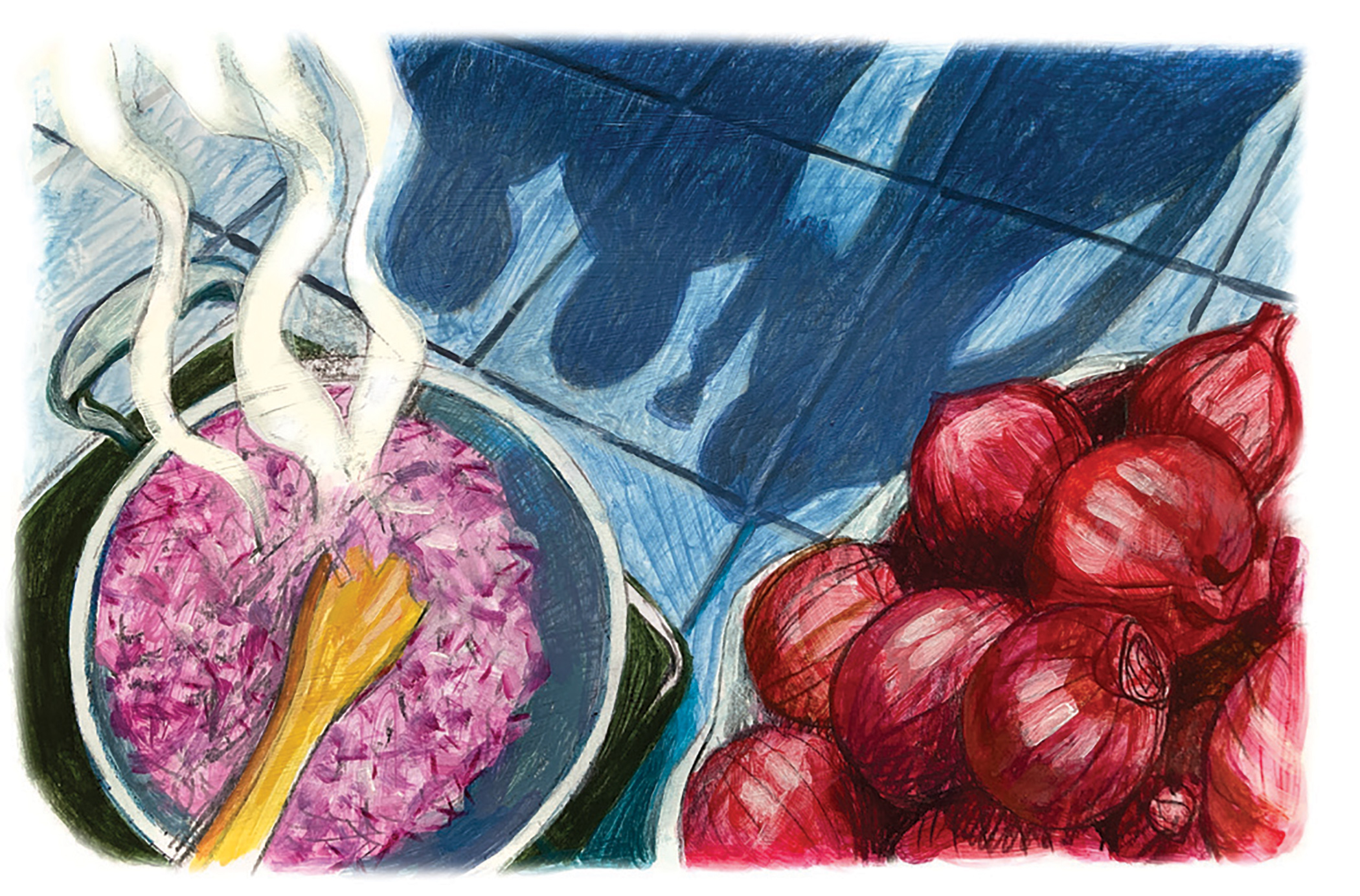
If you walk through the residential neighbourhoods of Addis Ababa during one of the major holidays, you’ll no doubt encounter the unmistakable smell of doro wot.
A rich and buttery Ethiopian chicken stew, doro wot is a joy to eat, but making it is another story. The onion heavy dish has to be cooked for several hours before the chicken ever makes an appearance, and you’d be wise to prepare it outside – or risk smelling like onions for days to come.
Last Christmas I decided to cook this quintessential Ethiopian meal and invite my friends over to celebrate. The person There are two different people: the person who made this naïve decision, and the person I am today. I emerged from the experience exhausted and eternally grateful to my mother, my sister and the countless women who have fed and nourished me over the years.
Making doro wot requires numerous stages and kilos upon kilos of onions – depending on how many people you’re feeding, and a special kind of grit that Ethiopian women seem to pass down from generation to generation. The dish can take three days to make: the first for peeling and chopping onions, the second for cooking them with spices and the third adding chicken and boiled eggs.
In Ethiopia, where Orthodox Christianity is the dominant religion, Christmas is celebrated on 7 January. I began the doro wot-making ritual (there’s no other word for this) at 6.00pm the evening before. Thankfully, I had already prepared six kilograms of onions the previous night – peeled and chopped, with plenty of tears shed in the process.
I spent the first couple of hours just cooking the raw onions until all the water evaporated, and I was left with a quarter of what I started with. As I stood there stirring, enveloped in a haze of onion fumes and rising irritation, I thought about how cooking – particularly this type of cooking – is often a thankless task expected only of women. Although there’s some pushback among the urban youth, the reigning belief is that ‘a woman’s place is in the kitchen and a man’s is in court’, in the words of a popular Ethiopian expression. I was livid – but I kept on stirring.
Once the water evaporated, I added copious amounts of oil (most people use butter), and started sautéing the onions. This process, like the one before it, requires constant vigilance, making sure that each piece of diced onion is cooked evenly, without burning or sticking.
By the fifth hour, my anger had turned into resignation. I thought about how cooking isn’t a choice for most Ethiopian women. It’s not something done on a whim (as I had done), but an obligation to be performed day in, day out. My thoughts also went beyond Ethiopia, to the unpaid labour that women shoulder around the world – equivalent to $11 trillion globally.
By the time the onions had reached a glossy deep brown, and I had added the berbere (an Ethiopian red pepper powder spice blend) the sun was long gone, and my thoughts had shifted again. I remembered all the meals that my mum had prepared for us growing up, and a wave of overwhelming gratitude washed over me. I began to rethink what I had earlier framed as a lack of choice or agency. I thought how, like my own decision to cook and share a meal with friends, this is also how many other women show their love and care.
Seven hours into the process, the sauce was complete (you add some water along the way, though purists may disagree). And finally I added the boiled eggs – skipping the chicken, since I’m a vegetarian (which would certainly enrage the purists).
The best part, of course, is eating the doro wot. But I think that anyone who expects this dish from their wife, mother, sister, or daughter, should also go through the rite of making it themselves.
